
When configuring energy storage (battery) with the eGauge, there’s a few things to know:
- From the eGauge configuration guide: “Typically, renewable energy systems should read positive when there is active generation, and battery systems should read positive while charging and negative while discharging.”
- I have J&D CTs on my batteries with the arrow on the Current Transformer pointing away from the batteries. The arrow orientation varies by CT maker so look it up. Or use Channel Checker and verify that the Battery registers are reading positive while charging and negative while discharging.
- Unlike solar, the battery loads are NOT balanced. You must use a clamp on each leg of the split-phase feed.
- The formula for each battery Register is: P = S{NN} x L1 and P = S{NN} x L2
- For the Battery Virtual Register, use: Battery = – Batteries L1 – Batteries L2
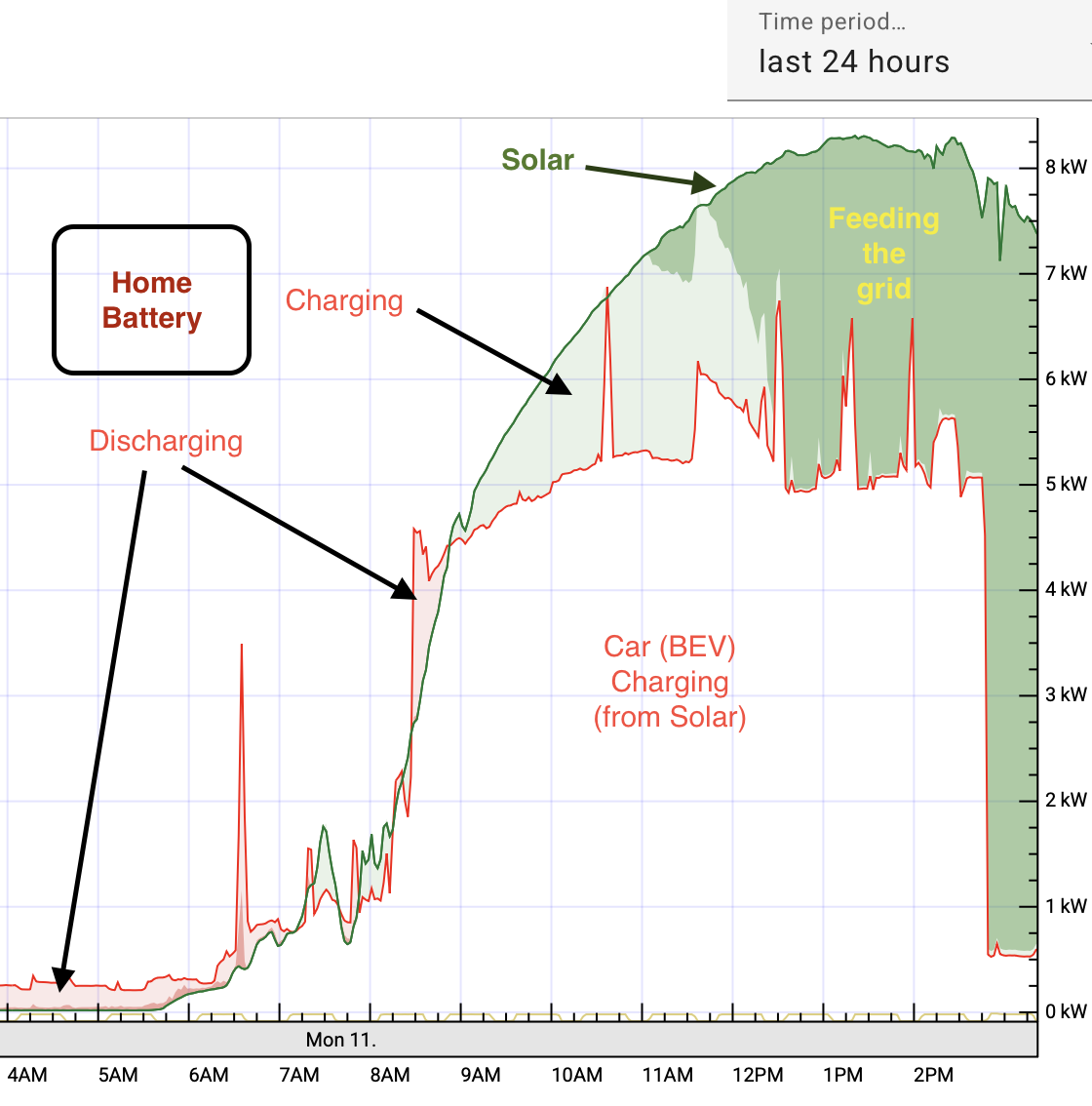
Then you’ll get a nice graph that looks something like this:
Background: My solar installer included an eGuage 3010 energy meter when they installed my first array in 2016. It was a solid piece of kit but it got quite slow when I added more CTs. I replaced it with a 4115 that’s plenty quick and has 15 CT ports and they’re all in use. In fact, I had to unplug the fridge CT to make a space for the 2nd leg of the battery circuit. The only way I’ve seen to improve on an eGauge is the span electrical panels.
You must be logged in to post a comment.